There is a question we seldom ask about education:
What happens when the learner leaves school and nobody tells them what the problem is?
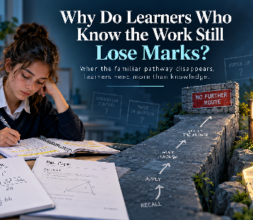
At school, the question is usually visible. It appears on the worksheet, on the board or on the examination paper. The learner knows that there is a problem to solve and, in most cases, which section of the curriculum contains the knowledge needed to solve it.
Life is different.
A business plan stops working. A machine suddenly sounds different. A relationship changes. A customer behaves unexpectedly. New technology changes a profession. Something that worked yesterday no longer produces the same result today.
Nobody raises a hand and announces:
“Attention. You have now reached Question 7. Please identify the problem and show all your working.”
That difference lies at the heart of The Power of NEXT.
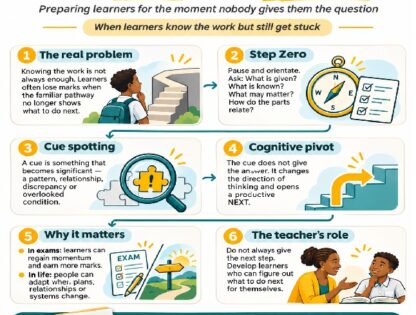
Knowing is not the same as moving
Knowledge matters. A person cannot think meaningfully about something they know nothing about.
But knowledge does not automatically produce movement.
A learner may know a formula yet not recognise when to use it. A manager may know the organisation extremely well yet continue with a strategy after the environment has changed. A skilled professional may possess years of expertise and still overlook the one small change that should trigger reconsideration.
The deeper capability is not simply knowing more.
It is being able to recognise:
Something has changed.
Something does not fit.
Something here deserves another look.
That moment can become the beginning of a NEXT.
The world rarely follows the recipe
Much of conventional education is necessarily built around pathways.
The teacher explains.
The learner practises.
The method is repeated.
Accuracy improves.
There is nothing inherently wrong with this. Methods, procedures and worked examples are essential parts of learning.
The danger arises when learners begin to believe that every future problem will present itself in a recognisable form with a familiar recipe attached.
Real life does not work like that.
Sometimes the recipe works perfectly.
Sometimes it works for the first three steps and then stops.
Sometimes the real problem is not the one you initially thought you were solving.
And sometimes the most important thing a person can do is stop.
Not give up.
Stop long enough to notice that continuing in the same direction is no longer productive.
That pause is cognitively powerful.
The NEXT begins before the answer
The Power of NEXT is not about having a clever answer ready.
It begins earlier.
A person first has to recognise that the current pathway has reached its limit.
Then comes a different question:
What am I not noticing?
That may mean looking at the situation from further away or much more closely. It may mean comparing something that was previously treated separately. It may mean questioning an assumption, noticing a contradiction or recognising that an apparently insignificant detail has suddenly become important.
That significant feature becomes a cue.
The cue does not solve the problem.
It changes the direction of thinking.
And that change creates the possibility of a productive NEXT.
Why the teacher should not always provide the NEXT
This has an important implication for teaching.
When a learner gets stuck, adults are naturally tempted to help.
We explain again.
We point to the relevant line.
We ask a highly directional question.
We demonstrate the next step.
The learner moves again — and everyone feels relieved.
But there is a hidden question:
Whose cognition restored the movement?
If the teacher spotted what mattered, selected the new direction and supplied the next step, the learner may have completed the problem without developing the capability to regain movement independently.
Sometimes good teaching therefore requires something counter-intuitive:
Do not give the NEXT too quickly.
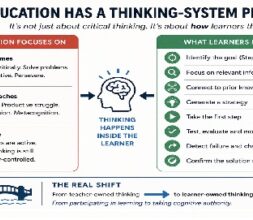
The learner needs opportunities to experience uncertainty, search, reconsider, test possibilities and recover.
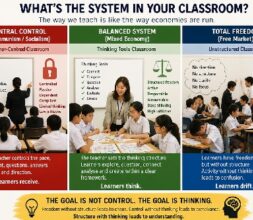
The teacher becomes less like a GPS that announces every turn and more like a designer of environments in which learners gradually develop their own compass.
Step Zero changes the starting point
This is why Step Zero is important.
Before rushing into a solution, the learner establishes a cognitive starting position:
What is happening here?
What do I know?
What is given?
What appears important?
What relationships can I already see?
What am I actually being asked to determine?
Step Zero slows the urge to grab the first familiar method.
It creates an orientation from which thinking can begin.
More importantly, if the learner later gets stuck, there is somewhere cognitively useful to return to.
Instead of merely saying, “I don't know what to do,” the learner can revisit the original landscape and ask:
What has changed in the way I am seeing this?
The Power of NEXT is not only about examinations
An examination makes the problem easy to see because the question is printed on the page.
But the capability is much bigger than examination success.
Consider the experienced mechanic who hears a slight change in an engine.
The parent who realises that a child's behaviour is not simply “naughtiness” but may be signalling something else.
The entrepreneur who notices that customers have stopped responding to an offer that worked six months ago.
The doctor who sees that one symptom does not fit the expected pattern.
The teacher who recognises that explaining the same concept for a third time is unlikely to solve the learning problem.
In every case, progress may begin with the same cognitive event:
Something becomes significant.
That cue interrupts automatic thinking and creates the possibility of another direction.
The learner of the future needs more than answers
Artificial intelligence makes this issue even more urgent.
Information is becoming easier to obtain.
Answers are becoming easier to generate.
Explanations can be produced in seconds.
That makes the uniquely educational question even more important:
Can the learner recognise what matters?
Can the learner identify the real problem?
Can the learner judge whether an answer makes sense?
Can the learner notice when the first approach is failing?
Can the learner generate another direction rather than immediately asking someone — or something — to provide it?
AI can become an extraordinary cognitive partner.
But if it continually supplies the NEXT before the learner has had an opportunity to search for one, it can also become the world's most sophisticated answer machine.
The educational goal should therefore not be to protect learners from AI.
It should be to develop learners strong enough to use AI without surrendering ownership of their thinking.
From answer-getting to cognitive mobility
This requires a subtle change in what we value.
Instead of asking only:
Did the learner get the answer?
we also need to ask:
What did the learner do when the answer was not immediately visible?
Did they stop?
Did they recognise that the current route was failing?
Did they return to what they knew?
Did they notice something new?
Did they test another possibility?
Did they recover?
That is cognitive mobility: the capacity to initiate, sustain or regain cognitive movement when familiar knowledge, methods or pathways no longer provide sufficient direction.
And perhaps this is one of the most important capabilities education can develop.
Because after school, the learner will repeatedly encounter problems for which there is no memorandum.
The question every teacher and parent can start asking
The Power of NEXT does not require abandoning content, direct teaching or established methods.
It asks us to add one more question to our teaching:
Who is generating the NEXT?
Every time the adult supplies it, the learner progresses.
Every time the learner discovers it, something more may happen:
the learner becomes slightly better prepared for the day when the teacher, parent, tutor or textbook is no longer there.
That is ultimately the learner we need to develop.
Not merely someone who knows the answer.
But someone who, when the world no longer looks like the example in the textbook, can recognise what matters, change direction and move again.
In an examination, the question is printed on the paper.
In life, nobody announces the question.
These ideas are explored in Dr Cas Olivier's book, The Power of NEXT: Discover the Teaching Secrets Behind Exam Success and Real-Life Achievement.
Download the book free:
learningdesigns.co.za/books