The political scenario
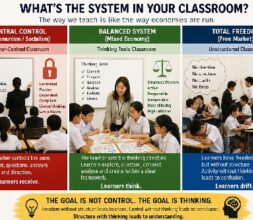
In politics and economics, we often speak about three broad systems:
- A blend of communism and socialism, where government controls business and economic activities;
- the free market, where individuals and businesses operate with maximum freedom; and
- the mixed economy, where freedom exists, but within a structure of rules, responsibility, and accountability.
This same pattern can help us understand what is happening in many classrooms.
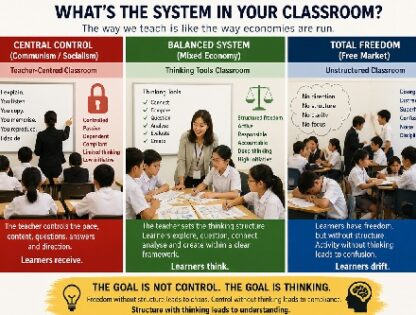
A fully teacher-controlled classroom is like a communism-socialism economy where the centre controls everything. Like the government, the teacher controls the content, the pace, the questions, the examples, the answers, and often even the thinking. Learners are expected to sit, listen, receive, copy, and reproduce like workers in a communist-socialism system who carry out instructions.
Communism-socialism misreads human nature when it treats people primarily as workers who must carry out instructions. People are are problem-solvers, risk-takers, improvers, traders, creators, organisers, and opportunity-seekers. When these capacities are over-controlled, society loses initiative.
In a communist-socialist system, the state tries to control production, prices, resources, and economic direction from the centre. But ordinary citizens often see opportunities before the state does. They notice gaps, needs, inefficiencies, local problems, and new possibilities. That is the entrepreneurial mind at work.
The result is that when a system removes ownership, reward, initiative, competition, and personal responsibility, it weakens the very human energy that creates growth and innovation. Does this sound familiar when looking at the education systems who reached it shelf life?
This same pattern can help us understand what is happening in many classrooms
As in government and economic systems, we also find socialist-communist teaching patterns in classrooms. These are teachers who believe that the centre must control almost everything: the content, the pace, the examples, the questions, the answers, the method, and often even the acceptable route to understanding.
The socio-communist approach to teaching
They are the teachers who carry the full weight of learning on their own shoulders. They explain more, control more, repeat more, correct more, and manage more — while learners gradually become dependent receivers rather than active meaning-makers.
This does not mean such teachers are careless or uncommitted. In many cases, they work extremely hard. The problem is not their dedication. The problem is the teaching model. When learning is over-centralised, learner initiative weakens. Learners wait for instruction, hesitate to think independently, and often step out of pace when their own thinking energy has nowhere productive to go.
In the meantime, in the world outside school, learners have already discovered that they can search, choose, compare, create, communicate, and solve problems with remarkable independence. They live in a world of technology, games, social media, online searches, creative tools, and instant feedback systems. They know what it feels like to control direction, make choices, explore possibilities, and receive immediate responses. They create digital content. They play complex games. They communicate instantly. They navigate information-rich environments. They are used to interaction, feedback, and choice.
Then they enter a classroom where their role is reduced to listening, copying, waiting, and reproducing. This mismatch creates tension. When they step out of the prescribed pace, this is regarded as disobedience, disruption, lack of discipline, or resistance.
So-called misbehaviour
Learners start stepping out of pace, and this is often regarded as misbehaviour. It is the learner’s entrepreneurial mind at work — seeing a gap, testing a possibility, asking a question, or trying to make meaning beyond the teacher’s central plan.
This is one of the reasons why many teachers feel that teaching no longer has the characteristics they dreamed of when they first decided to become teachers. Instead of experiencing teaching as a meaningful profession of awakening curiosity, guiding discovery, and developing young minds, they experience it as a daily struggle for control, compliance, curriculum coverage, and discipline.
Teachers leaving the profession
Over time, this mismatch drains professional meaning. Teachers who entered the profession to inspire learning may find themselves managing resistance, enforcing pace, and carrying the full burden of motivation from the front of the classroom. This contributes to frustration, burnout, and, for some, migration out of the classroom into administrative roles, alternative education spaces, tutoring, training, or entirely different professions.
Free market classes.
This is also familiar in education. A classroom that gives learners total freedom without enough thinking structure may appear learner-centred, but it can quickly lose direction. They may talk, move, explore, and choose, but without a clear cognitive pathway, learning can drift into noise, shallow activity, confusion, and discipline challenges. This is often seen in supervision classes, where a teacher stands in for an absent colleague but receives no clear instruction to teach, facilitate, or structure the learning.
The problem is not freedom itself. The problem is freedom without structure.
The most successful market economies are not successful because they are totally uncontrolled. They are successful because they combine freedom with structure: initiative, ownership, enterprise, and competition operate within rules, trust, accountability, and strong institutions.
The mixed economy Thinking Tools figure out teachers
As with the mixed economy, the solution is not found in either extreme. A healthy economy does not depend on total state control, nor does it survive well as uncontrolled freedom. It needs freedom, initiative, ownership, and entrepreneurship — but within a structure of rules, responsibility, accountability, and stewardship.
In the same way, the best classrooms are not fully teacher-controlled and not totally learner-free. They combine learner agency with thinking structure. The teacher does not suppress initiative; the teacher channels it into disciplined, productive thinking.
The Thinking Tools win-win classroom.
A healthy classroom does not depend on teacher control, nor does it flourish through unstructured learner freedom. Learners need space to think, question, test, discover, and create meaning — but within a carefully designed thinking structure.
This is where the Thinking Tools Classroom becomes the educational equivalent of a mixed economy: the teacher provides structure, direction, questions, boundaries, and cognitive stewardship, while learners bring initiative, curiosity, and meaning-making. A Thinking Tools Classroom creates this disciplined middle ground: the teacher structures the thinking pathway, while learners do the thinking.
The answer is not to return to tighter control. It is also not to release learners into unstructured freedom. The answer is structured discovery.
A Thinking Tools Classroom sits in the productive middle.
- It is not teacher domination.
- It is not unstructured learner freedom; it is structured discovery.
- The teacher structures the thinking pathway.
- The learners do the thinking.
The teacher still leads but no longer dominates. Learners are active, but not directionless. The teacher structures the thinking pathway, while learners do the thinking.
This is the essential shift.
This changes discipline at its root. Not all behaviour problems disappear. A classroom still needs boundaries, routines, respect, and leadership. But discipline improves when the learner’s mind is meaningfully occupied. The teacher no longer has to carry the full weight of control alone, because the learning process itself begins to hold the learner’s attention.
Curiosity becomes stronger than compliance.
The 21st-century teacher cannot merely be a transmitter of knowledge. That role is too small for the complexity of the modern learner.
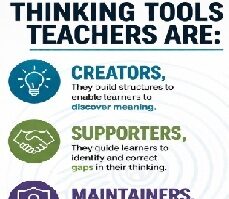
Teachers now need to become creators of thinking strategies, cognitive enablers, and facilitation artisans.
They create thinking strategies that use the curriculum as the learning ground.
They provide safe learning environments where learners can recognise their strengths and gaps, repair their thinking, and grow towards independent understanding.
This is not weaker teaching. It is stronger teaching.
It requires more professional judgement, not less. The teacher must know when to ask, when to wait, when to redirect, when to scaffold, when to create a learning pit, when to validate closure, and when to move forward.
The teacher becomes a steward of thinking
Step Zero is one of the unique features of a Thinking Tools Teacher.
The world outside school no longer rewards learners for merely receiving information. It rewards those who can make sense of information, solve problems, adapt to new contexts, develop insight, and create knowledge independently.
Classrooms must therefore change. Not into chaotic spaces of unstructured freedom. Not back into rigid spaces of teacher control. But into structured thinking environments where learners are guided to become independent meaning-makers.
The future belongs to classrooms where the teacher structures the thinking, and learners do the thinking.