The greatest gift is not the answer. It is the ability to figure out what to do when the answer is not immediately obvious.
Download your free copy of the book The Power of Next
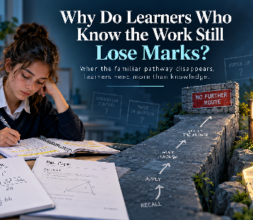
Imagine your child at the kitchen table, stuck on a maths problem. They’ve tried. The answer is wrong. Frustrated, they drop the pencil and say: “I can’t do maths!”
The natural response is: “Of course you can! Just try again.”
Encouragement is kind, but it rarely helps a child see what went wrong or how to move forward. The moment they get stuck is not just an emotional moment — it is a thinking moment.
Your child needs more than encouragement
When a child gets stuck, the instinct is to explain the method, show the next step, or simply reassure them. These responses are well-intentioned, but they often restore movement without developing the child’s ability to restore it themselves.
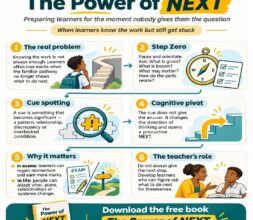
This is where The Power of NEXT matters.
Instead of immediately correcting, try this short sequence:
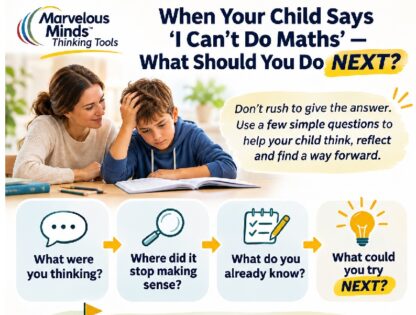
- “Show me what you were thinking.” Let them explain their reasoning out loud. Listen without interrupting.
- “At which point did it stop making sense?” Help them locate the exact moment the pathway ended.
- “What do you already know that might help?”
This returns them to Step Zero — what is given, what is known, what relationships exist.
- “What could you try NEXT?” Ask them to suggest one possible next move. It does not have to be correct. The value is in generating it.
You are no longer just fixing a maths problem. You are helping them notice their own thinking.
From your questions to their own thinking
At first, you ask the questions. With practice, your child begins to ask them independently:-
- “What do I already know?”
- “Does this answer make sense?”
- “Where did it stop working?”
- “What could I try NEXT?”
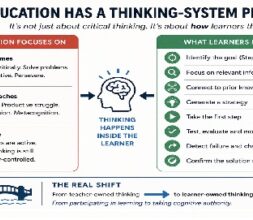
This is the shift from needing external direction to developing cognitive mobility — the ability to recognise when a familiar pathway has ended and to generate a productive next step without someone else supplying it.
When should you help?
Explanation is never the an option. The moment you fully explain the method, you are telling the child that they cannot figure it out themselves.
Help comes through scaffolding, not explanation.
Scaffolding keeps ownership of the thinking with the child. You supply the smallest possible support that allows them to move again, then you step back.
Use scaffolding when:
- The child has no relevant prior knowledge for the concept.
- They have already tried to reorient and are still completely blocked.
- The gap is a missing fact or method they have not yet been taught.
- Time or emotional load makes further struggle unproductive.
Even then, do not take over. Scaffold lightly:
- Ask a focused question that points to what matters without giving the method.
- Offer a single piece of information or a hint, then hand the thinking back.
- Say: “What could you try NEXT with this?”
The goal remains the same: the child generates the NEXT.
The greatest gift is not the answer. It is the ability to figure out what to do when the answer is not immediately obvious.
That is The Power of NEXT.
The goal is not to withhold help. It is to avoid supplying the NEXT before the child has had a chance to search for one.
The aim is not simply to replace “I can’t do maths!” with “I can do maths!”
It is to help your child say:
“I don’t understand this yet. What do I need to figure out NEXT?”
That is the difference between encouraging a growth mindset and building the thinking process that makes independent learning possible.