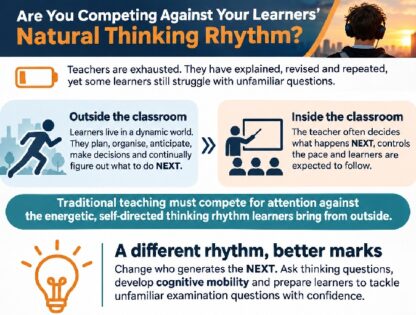
As another school year ends, many teachers are exhausted. They have explained, demonstrated, revised and repeated. Yet when the results arrive, some learners still struggle with unfamiliar questions.
What if the problem is not how hard teachers work, but the thinking rhythm of the traditional classroom?
Traditional teaching starts at a disadvantage
Outside the classroom, learners live in a dynamic world. They plan, organise, anticipate, make decisions, solve unexpected problems and continually figure out what to do NEXT. They are used to helping shape what happens next.
Then they enter the classroom.
Suddenly the rhythm changes. The teacher decides what happens NEXT, explains the methods, asks the questions, controls the pace and decides when to move on. Learners are expected to follow.
Traditional teaching must now compete for attention against the energetic, self-directed thinking rhythm learners experience outside school. Keeping them engaged becomes yet another demand on already heavy workloads.
What if we changed the rhythm instead?
The solution is not necessarily faster lessons, more entertainment or harder work from the teacher.
The opportunity lies in changing who generates the NEXT.
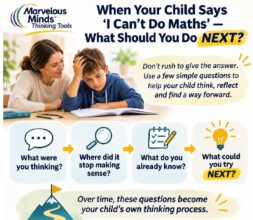
Imagine a mathematics lesson where the teacher presents an unfamiliar problem and asks:
- What do you notice?
- What do you already know?
- What relationships can you identify?
- What could we investigate NEXT?
From cognitive engagement to better marks
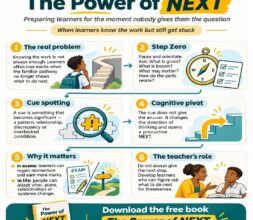
This is the thinking behind The Power of NEXT and Thinking Tools. Learners develop cognitive mobility — the ability to regain direction when familiar methods no longer work.
They learn to recognise when they are stuck, reconsider their approach, investigate alternatives and generate a productive NEXT.
Why does this matter for examination results?
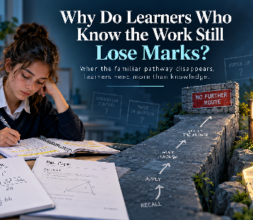
Examinations do not always present questions exactly as they were practised. A learner may know the content yet stall when the question appears in an unfamiliar form.
Better marks require more than remembering what was taught.
Stop competing with your learners’ natural thinking rhythm.
Bring that rhythm into your classroom.
That is The Power of NEXT
Discover how Thinking Tools and The Power of NEXT can help you teach differently next year.
Download your free copy of my book: The Power of Next