Read this blog hand in hand with Inside the Marvelous Mind: From Mimicry to Mastery
This blog is a next dimension in the cognitive knowledge explosion as described in the blog From Cosmic Shifts to Cognitive Revolutions: Rethinking the Center of Learning
Before 1510 everyone believed that the earth is the centre of the 'universe'. Nicolaus Copernicus discovered that the Sun—not the Earth— is the gravitation center of our solar system.
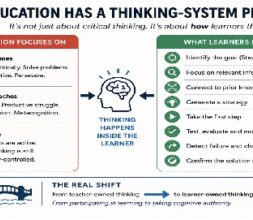
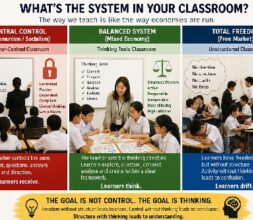
500 years later, in 2010, Cas Olivier introduced a paradigm shift just as radical—this time in education. He discovered that the gravitation center of learning is NOT the teacher, the textbook, or the curriculum. The Instead, the gravitation center of learning is the learner’s brain.
This model marked a major paradigm shift in education—decentering the teacher from the learning process and laying the foundation for brain-aligned, self-directed learning.
500 years later, in 2010, Cas Olivier introduced a paradigm shift just as radical—this time in education. He discovered that the gravitation center of learning is NOT the teacher, the textbook, or the curriculum. The Instead, the gravitation center of learning is the learner’s brain.
The human brain isn’t built to merely copy. It’s built to plan, analyse, develop, and create. While mirror neurons offer the ignition spark—through mimicry and emotional resonance—true learning requires more than following. It demands an engine for cognition. That’s where Thinking Tools come in.
To explain this partnership, let’s borrow from the world of Formula 1 racing.
The F1 Brain is a Hybrid Learning Engine
Modern Formula 1 cars are hybrid machines. They run on both:
- A traditional combustion engine (for raw acceleration), and
- An electric motor (for instantaneous boost and energy recovery).
Separately, each system has limits. But together, they enable speeds over 350 km/h.
Now compare this to the brain:
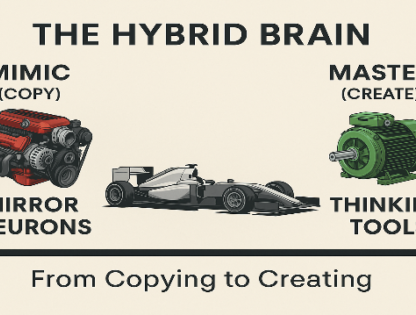
- Mirror neurons are like the combustion engine. They fire automatically when we see others act, yawn, smile, or make mistakes. They allow us to empathize, rehearse, and respond.
- Thinking Tools are the brain’s electric motor—silent but powerful. They resemble the electric motor that kicks in when needed They structure, elevate, and refine raw mental energy into clarity, creativity, and insight.
Both the mirror neurons and Thinking Tools which are supporting cognitive thinking are inborn tools.
Babies are born with mirror neurons. These neurons or brain cells learn through mimicry when observing their mothers. During the first months of life these mirror neurons help them to learn how to:
- Stick out their tongues
- Open their mouths
- Raise their eyebrows
- Follow their mother’s eyes
- Smile without truly understanding what a smile means
These early imitation forms the foundation of learning. Interestingly, birds learn only from their parents through mimicry—and then never learn anything new. On the other hand, mammals like dogs, cats, and apes can also learn by mimicking others of their species.
Although mimicry is a primitive mode of learning formal education remained stuck at this mode. Evidence of this is why teaching often means: “I explain. You copy me. You get marks.”
Platforms like YouTube and in some cases, AI promote mimicry learning: You watch. You do. You get smarter. The thinking, however, still belongs to someone else.
What Happens When Only the mimicry system runs?
Learning through mirror neurons is fast—but shallow. It works, but it doesn’t empower. Just as an F1 car can’t win on the petrol alone, learners can’t succeed on mimicry alone.
Thinking Tools switch on the cognitive engine of the brain that enables learners to:
- Analyse, synthesize and evaluate information
- Reorganize
- Compare and contrast
- See relations
- Transfer insights to new contexts
- Obtain vision and clarity
- Explain concepts in their own words
The brain, with its built-in mirror neurons and Thinking Tools, becomes a hybrid thinking system. This is why learners who use Thinking Tools grasp new concepts faster, gain more insight and achieve better marks.