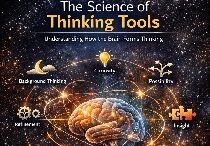
Where is the science of Thinking Tools?
When people ask, “What is the science of the Fourth Education revolution?” it means that there is no science language to communicate within the professions, worse there is no common language to communicate with parents, learners, government departments and the media.
The reason is that in most cases ingenuity was ahead of recording the science, except in the case of Thinking Tool. The first book describing the outcomes-based approach was published in the late 1990s followed by the DNA of Great Teachers, in 2000.
As time went by new practices were recorded, tested, refined and published.
As with other professions, such as medicine and engineering, many new inventions were first on paper and then tested, validated and incorporated into the science or discarded.
The science of Tbrain-based teaching emerged from a coherent view of how thinking forms, how learning stabilises, and how understanding becomes transferable.
What makes this a science is that these patterns are not random, and they are not invented. They are observable, repeatable, and consistent across time, context, and individuals. When examined closely, they reveal that thinking follows a lawful order.
In the book, The Thinking–Learning Universe, this order is described through a set of underlying principles of thinking. These principles do not belong to a method or a curriculum. They describe how the brain naturally moves when it is allowed to organise meaning before and without schools.
From the moment the mind drifts from daydreaming to the point where curiosity takes hold, to the exploration of possibilities, the refinement of ideas, the alignment into logical structure, the emergence of insight, the integration into a bigger picture, and even the incubation that happens beyond conscious control, the brain follows a recognisable pattern.
Thinking principles
The thinking principles are not steps to be followed. They are principles that govern how thinking unfolds. They are not strategies or ideas — they are the underlying laws of how thinking forms. They can be observed in the work of learners, in classrooms, and across the history of discovery itself.
At its core is a simple but powerful realisation: learning is not the transmission of knowledge; it is the organisation of coherence.
This immediately shifts the conversation. If learning is about coherence, then the question is no longer what the teacher explained, but what structure the learner’s brain formed. This is where Thinking Tools positions itself differently—not as a method, but as a science of how thinking forms.
The pillars of the Thinking Tools science
One of the foundational elements of this science is what we call Step 0. Step 0 is not a strategy, a study skill, or something added to learning. It is what happens before visible thinking begins. It is the moment where the brain orients itself, frames the situation, senses direction, and prepares for meaning. It is the quiet cognitive ignition point from which all thinking emerges. Without Step 0, learners do not truly begin thinking—they begin reacting.
A second pillar of this science is that learning is biological. The brain changes when it learns. This is not a metaphor—it is grounded in neuroplasticity. Every time a learner makes sense of something, detects a pattern, or connects ideas, the brain is physically reorganising itself. This means learning is not what is covered; learning is what is constructed. And construction requires structure.
A third pillar is that thinking is not linear or isolated. The brain does not move through neat steps like a checklist. It works in integrated, shifting modes. When learners are truly thinking, their minds do not move in one fixed way. Sometimes the brain goes on a fact-finding mission, searching, gathering, and exploring. Sometimes it tries to establish clear steps, bringing order and sequence. Sometimes it looks for alternatives, asking what else could this be. Sometimes it begins to detect or even predict mistakes before they happen. At times, thinking shifts into cause-and-effect reasoning, while at other times it becomes comparison, weighing similarities and differences. Sometimes it moves into an if–then mode, testing possibilities and consequences. There are moments when learners go on a question spree, generating possibilities faster than answers, and other moments where they focus on locating precise answers, bringing clarity and closure.
These are not random behaviours, and they are not simply signs of engagement. They are observable patterns of how the brain organises thinking.
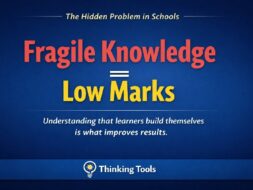
A fourth pillar is that thinking seeks closure. When the brain reaches a point where relationships connect, patterns settle, and everything makes sense together, understanding stabilises. This is what we call cognitive closure. Without closure, learning remains fragile, knowledge does not transfer, and performance collapses under pressure. With closure, learning holds, thinking becomes independent, and understanding becomes usable.
Thinking Tools is based on a coherent scientific model
When these elements are brought together, a coherent scientific model begins to form. Thinking begins with orientation in Step 0, learning is grounded in brain change through neuroplasticity, thinking operates through integrated modes rather than isolated steps, and understanding stabilises through cognitive closure. This is the science of Thinking Tools—not a collection of strategies, but a model of how the brain organises itself to form understanding.
What Thinking Tools does is to take these naturally occurring processes and organise them into a developmental system.
This provided a scientific language which resulted in structure that deliberately guides thinking, which is called the Mothership of all learning which makes learning that happens in the brain visible.
This is why it matters now more than ever. Education has already begun to shift. Teachers are moving away from explanation toward engagement. They are asking better questions and creating space for learners to think. But much of this shift is still intuitive, and intuition, while powerful, has limits.
List of resources of the science of Thinking tools
- Famous Step Zero moments in history
- Pre-planning or Step 0 is a cognitive placeholder for thinking
- Neuroplasticity: The core of learning and the key to revolutionizing education
- Thinking in layers: Why teachers must know the levels of thinking
- The Thinking–Learning Universe – A Practical Guide for the Einsteinian Classroom
- Cognitive closure (Repurposed)
- Why learners forget what they were taught