Your child may be capable of much more than their school marks suggest. The missing ingredient might not be more studying, but learning how to use the thinking abilities they already have.
When More Help Doesn't Solve the Problem
Your child studies for hours. You explain the work again. Perhaps you even pay for extra lessons.
Yet, when an unfamiliar question appears in a test, everything falls apart.
Your child says, “I don't know what to do.”
Naturally, you want to help. You explain the question, break it into smaller steps, demonstrate the method or show them how to find the answer.
And it works — until the next unfamiliar question appears.
But what if the real problem is not what your child doesn't know, but what they don't know how to do with what they already know?
This is where we need to rethink how we support children who struggle with learning.
Are We Supporting Learning or Replacing Thinking?
When a child struggles, we usually respond by providing more support.
More explanations. More examples. More worksheets. More repetition. More time.
But there is a question we seldom ask: Who is actually doing the thinking?
When the parent or teacher identifies the problem, selects the strategy, explains the steps and checks the answer, the adult may be doing most of the cognitive work.
The child follows.
The result may be a completed assignment, but that does not necessarily mean the child has developed the ability to complete a similar task independently.
We may unintentionally be creating dependence instead of developing thinking.
Your Child Already Has Thinking Abilities
Think about a young child playing with building blocks. Nobody has to formally teach that child to notice similarities, compare sizes, experiment with arrangements or discover why a tower keeps falling.
The child naturally explores, analyses, connects ideas, tests possibilities and learns from what happens. These are early expressions of powerful thinking abilities.
Yet, as children progress through school, learning can become increasingly dependent on adults explaining what to think, which method to use and what answer to produce.
Some children become very good at following instructions but struggle when those instructions disappear.
The problem may not be the absence of thinking abilities. It may be insufficient opportunity to develop, coordinate and use them independently.
Of course, genuine cognitive difficulties do exist. Children differ in working memory, attention, language processing and other abilities. Some need specialist intervention or accommodations. But difficulties should not automatically lead us to underestimate what a child can learn to do.
The Missing Step: Learning How to Begin Thinking
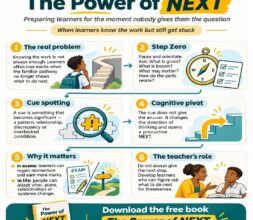
At Thinking Tools, we introduce a simple but powerful practice called Step Zero.
Before rushing into a question, your child learns to orientate their thinking.
Instead of immediately asking, “How do I do this?”, they begin asking:
- What is this question about?
- What information has been provided?
- What do I already know that might be useful?
- What am I being asked to discover?
- Which of my Thinking Tools could help me find a starting point?
This small change matters. The learner is no longer waiting for somebody else to provide the first step. They are beginning to take responsibility for finding it.
And once they start, they learn to analyse, compare, connect, question, evaluate and test possibilities. These abilities become more useful as children practise applying them when challenged.
What Happens When Your Child Gets Stuck?
This is perhaps the most important moment in learning. A child reaches a question they have never seen before. The familiar method doesn't work.
Traditionally, this is often the moment when someone steps in to explain. But imagine something different.
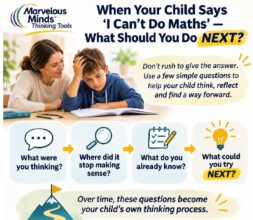
Instead of giving the answer, you ask:
“Show me what you were thinking.”
“Where did it stop making sense?”
“What do you notice that might be important?”
“What else could you try?”
Now your child must reconsider the problem, investigate another possibility and decide on a next move.
At Thinking Tools, we call this developing Cognitive Mobility — the ability to regain direction when familiar approaches no longer work.
Cognitive Mobility is not about always knowing the answer. It is about learning how to find a way forward when you don't.
The First Time Is Evidence of Learning
Consider two children solving the same mathematics problem. The first has practised the method ten times and can reproduce it accurately.
The second encounters an unfamiliar variation, identifies the relevant information, explores a relationship, tests a possibility and discovers a solution.
Both may get the correct answer.
But the second child has demonstrated something particularly valuable: the ability to construct a way forward rather than simply reproduce a familiar procedure.
An unfamiliar problem solved through independent thinking provides powerful evidence of learning.
Mistakes become useful too. They reveal where thinking needs to be reconsidered, making feedback and correction possible during the learning process.
This is why we encourage learners to figure things out rather than simply wait to be shown.
Can Thinking Skills Actually Become Stronger?
Research provides encouraging evidence that children can improve how they plan, monitor and evaluate their learning.
This does not mean every underlying cognitive limitation can be eliminated, or that practising isolated brain exercises automatically improves school performance.
It means that children can learn to use effective thinking processes more deliberately, strategically and independently.
That is an important distinction.
At Thinking Tools, our aim is not simply to make learners better at completing familiar exercises. It is to help them become better equipped to approach unfamiliar challenges.
What Can You Do Differently as a Parent?
The next time your child says, “I can't do this,” resist the temptation to immediately explain the solution.
Give them an opportunity to think. Help them identify what they understand, recognise what is significant and investigate what might come next.
Provide guidance, when necessary, but gradually allow your child to carry more of the thinking.
You may be surprised by what emerges when your child is given the opportunity to discover their own next move.
Remember, the goal is not to withdraw support from a struggling child. It is to make support increasingly effective at developing independence.
The Real Question Every Parent Should Ask
Perhaps we have been asking the wrong question.
Instead of asking only:
“How can I help my child overcome weak thinking skills?”
We should also ask:
“How can I help my child discover, develop and use the thinking abilities they already possess?”
Because your child's next breakthrough may not come from another explanation, another worksheet or another hour of studying. It may come from discovering that they can figure out much more than they ever thought possible.
The ultimate goal is not a child who never gets stuck. It is a child who knows how to find their NEXT move.
Discover The Power of NEXT
At Thinking Tools, we help learners move from borrowed thinking to owned thinking — developing the confidence, strategies and Cognitive Mobility needed to approach unfamiliar learning challenges.
Stop simply providing the next step. Help your child learn how to uncover it.
Discover more at Learning Designs.