This blog is adapted from my book THE THINKING UNIVERSE, where I show how teacher and learner wellness emerges naturally when teaching aligns with the brain’s geometry.
Parents worry about video games. Teachers worry even more.
Why can a child focus intensely for hours on a game…
…but lose attention within minutes in a classroom?
The answer is not a mystery, and it's not misbehaviour.
It’s architecture.
Games follow the brain’s wiring. Traditional teaching often doesn’t.
But Thinking Tools does.
This blog explains how Step Zero, Thinking Maps, and the curved classroom recreate the same reward architecture that makes games irresistible — and redirect it toward deep, meaningful learning.
1. Step Zero: The Brain’s Ready-Up Screen
Step Zero avails all the resources needed to start the learning process — the same way a video game presents everything required to begin a level. Each Thinking Map becomes an incremental achievement toward the end goal, the educational equivalent of a micro-mission.
Learners never lose sight of the final accomplishment because the next step is always visible.
Like a game’s progression system, “eating the elephant bit by bit” releases continuous micro-rewards:
- endorphins
- Clarity
- certainty
- momentum
This emotional chemistry fuels motivation and heightens attention. It creates the same gravitational pull toward learning that games generate through clear goals and small wins.
In a curved classroom, this is the learner’s first experience of cognitive flow — the inner sense of:
I know what to do next… and I can do it.
2. From Preparation to Propulsion
As these micro-successes accumulate, Step Zero becomes more than preparation — it becomes propulsion.
Just as a well-designed game adjusts difficulty to keep the player in flow, Step Zero calibrates readiness so the challenge feels engaging without overwhelming. Because each map connects logically to the next, progress feels predictable and safe.
Traditional teaching breaks this rhythm by offering tasks that are:
- too big
- too vague
- too disconnected
Thinking Tools restores coherence by creating a visible progress map of learning.
Attention doesn’t drop.
Anxiety doesn’t spike.
The learner stays in motion, carried forward by the same reward architecture that keeps gamers immersed for hours — but now applied to deep thinking.
3. Why Thinking Tools Resonates Like a Game
Thinking Tools aligns with the brain’s natural reward circuitry — the very system video games exploit.
Parents often fear that games “steal” their child’s attention, but the truth is simpler:
🎮 games follow the brain’s geometry
🏫 schooling usually violates it
When teaching gains:
- clear goals
- a rhythm of small wins
- immediate feedback
- progressive difficulty
learning becomes as engaging as gameplay — without the escapism.
Thinking Tools turns the addictive pull of gaming into the gravitational pull of understanding.
Learners discover that their own thinking can be just as absorbing, rewarding, and alive.
4. What Game Designers Knew Before Schools Did
The video-game industry discovered the secret of holding attention long before education did.
Game designers — often guided by intuition rather than neuroscience — built worlds that align almost perfectly with the brain’s wiring:
✔ clear goals
✔ instant feedback
✔ progressive difficulty
✔ micro-achievements
✔ visible progress
It’s an accolade to them: they engineered engagement by instinct.
The tragedy is that education ignored these principles for decades.
Thinking Tools finally brings these brain-aligned motivational principles into the learning space — transforming attention into a natural outcome rather than a constant battle.
5. When Teaching Becomes Facilitation
This is why the classroom becomes a space where learning self-organises — a field where insight travels quickly because minds are aligned.
In this alignment, the teacher’s role becomes unmistakably powerful:
not to push information, but to facilitate a process that works with the brain’s wiring, not against it.
The teacher becomes:
- the architect of rhythm
- the conductor of clarity
- the guide who creates conditions for micro-achievements
The classroom begins to function like the cognitive equivalent of a well-designed video game — a place where clarity, progression, and feedback generate natural momentum.
6. A Classroom Soaked With Endorphins
A class like this becomes soaked with endorphins — not from artificial rewards, but from real learning.
Every time a learner completes a Thinking Map, sees the next step, or feels “I get it,” the brain releases micro-reward chemistry.
Soon the room begins to overflow with these wins.
Motivation leaks out of the classroom door the way excitement leaks out of a gaming session — only this time it is not escape, but engagement.
Not addiction, but alignment.
Not entertainment, but understanding.
7. The Curvature of Learning
When learners experience thinking as a series of small, winnable steps — the same architecture that makes games irresistible — the teacher no longer fights for attention.
Attention becomes the natural outcome of good design.
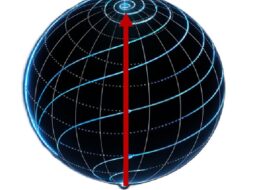
The curvature of the lesson pulls learners inward, the way gravity pulls planets into orbit.
The classroom becomes a field of coherence, where:
- thinking feels good
- progress is visible
- learning releases the same feel-good chemistry as gaming
- mastery replaces distraction
This is the curved classroom — where the physics of motivation meets the geometry of understanding.