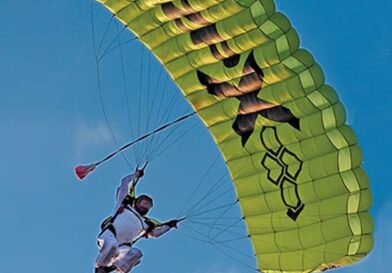
In skydiving, survival depends on something surprisingly small.
Before the main parachute opens, a tiny device called a pilot chute is released into the air. It is not designed to slow the fall. It is not large enough to save the jumper. Its purpose is more subtle — and more powerful. It catches airflow and triggers the deployment of the main parachute.
Without it, the main canopy remains packed.
Without it, there is no controlled descent.
Without it, survival is compromised.
Education has a similar mechanism.
When the Parachute Doesn’t Open
In many classrooms, we assume that if we “pack” enough content into learners, understanding will automatically deploy when needed.
But content inside a learner’s memory is like a parachute in a container.
It does not open itself.
Learners often appear to understand during instruction. They answer questions. They follow examples. They nod. But when independent application is required, the canopy does not inflate. The descent becomes uncontrolled.
We misinterpret this as lack of effort.
Often, it is lack of deployment.
The pilot chute in learning is scaffolding.
- Not over-helping.
- Not rescuing.
- Not simplifying to the point of dilution.
Scaffolding is the deliberate cognitive trigger that initiates deeper processing.
It might be:
- A well-timed comparison
- A structured thinking map
- A probing question
- A Step 0 orientation
- A relational bridge
The teacher does not open the learner’s parachute. The teacher ensures it opens itself. That is the difference.
Small Trigger, Large Effect
The pilot chute is tiny compared to the main canopy. Yet without it, nothing else works.
Similarly, structured scaffolds are often small interventions:
- “How is this similar to yesterday’s concept?”
- “What pattern do you notice?”
- “What changes if the context shifts?”
- “Classify before calculating.”
These prompts activate airflow — cognitive airflow.
When the learner engages, neural pathways begin to pull the conceptual structure out of storage. Understanding unfolds. Coherence inflates. Learning stabilises.
Why This Is Not Remedial
A pilot chute is not used only when something goes wrong. It is part of the original design. Scaffolding should not be reserved for struggling learners. It is not a repair mechanism. It is an activation mechanism. Traditional education often waits for failure and then introduces “support.” But by then, the learner has already experienced cognitive freefall.
Scaffolding as pilot chute is proactive. It ensures deployment before confusion accelerates.
Structure + Timing
A parachute does not open randomly. Deployment occurs at the right altitude.
Scaffolding also requires timing.
- Too early — and learners remain dependent.
- Too late — and cognitive overload sets in.
This is where rhythm matters. Sequencing matters. The Chronosensor matters. Learning durability is not only about structure. It is about when structure is activated.
The Deeper Implication
- Most classrooms focus on packing parachutes:
- Cover the curriculum.
- Complete the syllabus.
- Move to the next unit.
But survival in learning does not depend on packing. It depends on deployment.
The question is not: “Did I teach it?”
The question is: “Did the learner’s canopy open?”
A Final Reflection
When a skydiver jumps, freefall is expected. But freefall is not the goal. The goal is controlled descent.
In learning, confusion and struggle are natural. But uncontrolled cognitive descent is not the goal. The goal is structured understanding.
The teacher as pilot chute does not remove challenge. The teacher ensures that challenge opens into stability rather than collapse.
And sometimes, the smallest intervention is the one that saves everything.