Download The Brain-Based Field Guide to Learning for free.
Although this analogy is based on maths, it applies to all subjects.
If you walk from the South toward the North, you are facing north and will eventually reach the North.
But if you start walking east, you will never reach the North.
This happens because North and South are destinations, while East and West are directions.
The link to provide you with the FREE litmus test advantage to distinguish between old school and critical thinking lessons: THE FIELD GUIDE TO LEARNING - How to Recognise Real Thinking in the Classroom
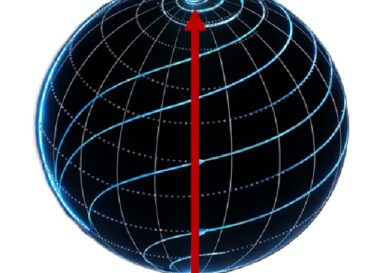
The image above illustrates two very different journeys toward mathematical success.
At the bottom (South) is the beginning of the learning journey.
At the top (North) lies the destination: strong mathematical understanding and high achievement.
The spiral path around the globe represents the long journey. The long journey = mastering of mathematical methods, while the short journey = understading the maths.
The Long Journey
In traditional mathematics teaching, learners are often taught methods first.
- Follow the steps
- Apply the formula
- Practise similar problems
- Repeat until the method is memorised
Although the journey is long and inefficient it can produce high marks - but at the cost of time which is a scarce comodity in teaching and learning.
Learners move slowly because they are trying to master procedures without fully understanding the structure behind them. When the problem changes slightly, confusion appears and the learner must start again.
Progress happens through many tedious repetitions and corrections, rather than through clear insight.
The Short Journey
When learners first figure out the structure behind the mathematics, understanding develops much faster. Instead of circling around the idea through repeated procedures, they move directly toward insight.
Once the structure is understood:
- methods suddenly make sense
- new problems become easier to interpret
- learners can adapt their thinking more easily
The learning journey becomes far more direct.
A Simple Way to Think About It
The difference is similar to embroidery.
One approach focuses only on the front side of the stitching — repeating visible patterns. The other approach understands the threads behind the pattern that create the design.
When the underlying structure is understood, the pattern becomes easy to reproduce.
The Real Goal of Mathematics Teaching
The goal of effective mathematics teaching should therefore not simply be to teach methods.
It should help learners see the structure behind the mathematics, allowing them to move along the short journey toward understanding instead of travelling the long spiral path.
High achievement is possible through both journeys. But one path takes far longer than the other.