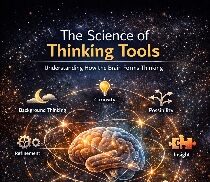
For a long time, education has tried to explain learning as an input-output process. After discovering the brain’s innate Thinking Tools, I suspected that there must be coordinating and system that does not work in a linear way.
It must be a central integrating system — a kind of cognitive “motherboard” that keeps thinking in motion and holds it together.
I eventually called this hidden organiser the Mothership of All Thinking.
Only later did I hear the cadence in the words:
Mothership… Motherboard… Mothership… Motherboard.
The analogy had been waiting until I wrote the book: The Thinking-Learning Universe
A computer does not function because it has a processor, memory, and storage. Those parts only become meaningful when they are connected and coordinated by the motherboard. Without that integration, the machine is not slow — it is non-functional.
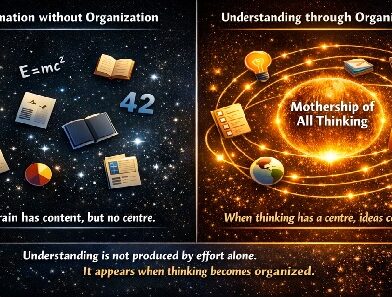
Thinking works the same way. A learner may have vocabulary, memory, effort and motivation, yet understanding may still fail to appear. Thinking does not arise from isolated abilities. It arises when those abilities become organised into a coherent system.
The Mothership of All Thinking does not store information and does not generate answers. Its role is relational and organisational. It:
- recognises cognitive tension when understanding begins to break down
- increases curiosity in response
- balances different kinds of thinking
- sequences ideas in time
- prioritises attention
- shifts between thinking modes
- sustains coherence over extended activity
In short, it allows thinking to behave like thinking instead of behaving like disconnected mental events.
The Importance of Timing
The analogy becomes clearer when we look deeper into how a motherboard works.
At the heart of every motherboard is a system clock — a crystal oscillator. It sends tiny electrical pulses at perfectly regular intervals to every component in the computer. The processor, memory and graphics card all wait for these pulses. Nothing operates continuously. Everything happens in timed steps.
Inside a computer the motherboard clock (the crystal oscillator) provides the timing reference for the CPU and most buses. The processor does not “run” continuously. It executes instructions step-by-step in synchrony with that clock signal.
If the clock signal disappears:
- the CPU cannot advance to the next instruction
- memory cannot coordinate reads and writes
- data transfers cannot be synchronised
The machine still has electrical power, but the system cannot operate as a system.
The brain appears to operate in a similar way.
The Mothership of All Thinking requires timing, and this timing function is what I call the chronosensor — the brain’s internal rhythm detector, sequence organiser and anticipation system.
The brain does not process information as a smooth stream. It processes in cognitive beats — not seconds on a clock, but moments of readiness for meaning.
What the Mothership Actually Does
A motherboard performs several essential functions: it connects components, regulates communication, determines compatibility, distributes timing signals and allows programs to run meaningfully.
The Mothership of All Thinking performs the cognitive equivalents:
- It connects ideas so relationships and patterns become visible.
- It organises meaning into structures.
- It aligns thinking through orientation before explanation (what I call Step 0).
- It provides cognitive timing through the chronosensor.
- It allows understanding to form rather than mere answers to appear.
Without this organisation, learning becomes fragile.
Why Students “Forget”
Consider the implication.
A powerful computer without a motherboard is not a weak computer. It is a dead machine.
Likewise, a learner with good memory, many lessons and countless worksheets, but without cognitive organisation, is not a weak learner. The architecture needed to stabilise understanding is missing.
Schools frequently upgrade curriculum, textbooks, assessments and technology. Yet they rarely address the cognitive architecture that organises thinking itself. As a result, learners metaphorically reboot every year. They pass tests but do not retain understanding.
They learned enough to answer. They did not learn enough to integrate.
A Living System, Not a Machine
The analogy with a motherboard is helpful, but it has limits. A computer motherboard is fixed circuitry. The brain’s integration system is alive.
It adapts, reorganises, strengthens pathways and changes with experience. When power is removed from a computer, nothing is retained. When thinking stops for the day, the brain does the opposite. Every act of thinking alters the field that will be used tomorrow. Connections consolidate, unused ones fade, and new patterns emerge.
The Mothership grows through use.
It remembers how it learned to remember.
Why Naming Matters
Historically we have lacked a simple concept for this integrative capacity. When something central remains unnamed, it cannot be deliberately taught, used or developed
This is why merely teaching “critical thinking skills” often fails. Skills alone do not converge. They require an integration system.
Parts of this phenomenon overlap with what neuroscience calls executive function and working memory. But experientially it feels simpler: it is the sense of being mentally present, aware and in control — the capacity to steer one’s own thinking while thinking.
The Mothership does not control thought. It makes thought possible.
It is the cognitive gravitational centre — not a location in the brain, but a field that stabilises thinking by shaping the space through which ideas move. Fields do not command from outside; they organise from within.
When learners begin to develop this integration, something remarkable happens. Curiosity, attention, questioning and insight stop competing and begin cooperating. Learning accelerates not because effort increases, but because alignment appears.
Understanding, then, is not merely the product of hard work.
It is the product of organised cognition.